
Construction
Built for job sites measured in years, not weeks
Hundreds of trades on a remote parcel with no sewer and a crew count that climbs every quarter. That is a standing contract, not a rental — and we staff it that way.
- 4-stall satellite units to cover large crews in a single drop
- Service frequency stepped up to multiple visits per week
- Holding tanks for office trailers and temporary hookups
Mon–Fri 7am–5pm · 24/7 emergency service available
Sound familiar?
- Unit counts that lag a crew ramping from dozens to hundreds
- Weekly service on a site that generates daily volume
- No sewer connection for site offices on an unincorporated parcel
- A vendor who cannot scale past a handful of units
A different kind of job site
Most construction rentals are a few units for a few months. A data center build is not that. Crews ramp from dozens to hundreds across multiple phases, the site often sits on a large unincorporated parcel with no sewer connection, and the work runs for years rather than seasons.
That changes what good service looks like. Unit counts have to be planned against a ramp schedule instead of set once. Service frequency has to be measured against actual traffic. And someone has to own the account rather than treating each call as a new order.
Covering a large crew
One per 10 workers is still the right ratio, but at a few hundred workers that math produces a lot of units. Two things make it manageable:
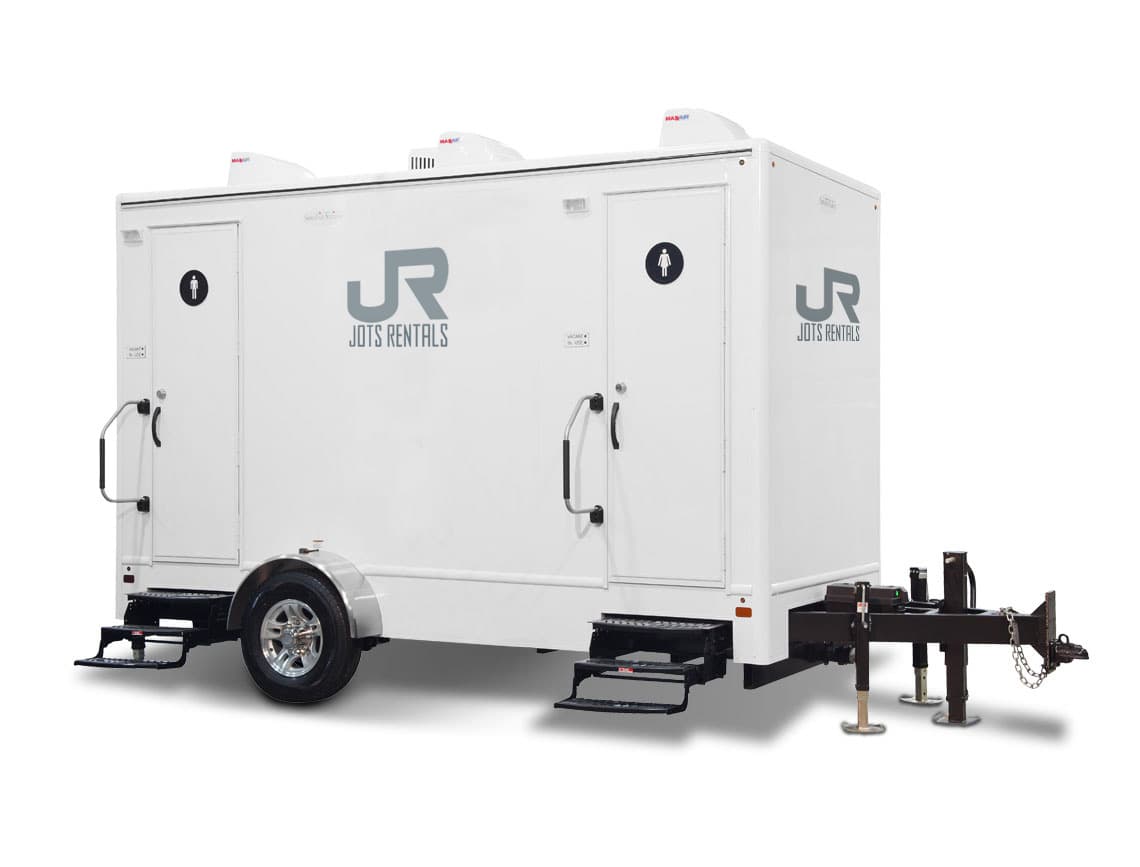
4-stall satellite units. One drop covers what four singles would, which cuts placement time, service time, and the number of things to keep track of.
Zone-based placement. Distributing units by work area rather than clustering them at the entrance is what keeps them actually used. On a large pad, a unit at the gate might as well not exist to a crew working the far corner.
Add ADA-accessible units where the site is publicly reachable, and hand-wash stations at every break area.
No sewer, no problem
Remote parcels rarely have a connection for site offices, trailers, and temporary facilities. Holding tanks solve it: a 250-gallon tank gives a trailer real waste capacity, and we set the pump-out schedule against how hard it is being used rather than a default.
Service frequency that matches the traffic
A weekly route is a starting assumption. On a site generating daily volume it is the wrong one. High-traffic zones move to twice-weekly or daily service, and the schedule gets set per zone — the trailer area and the far pad do not need the same thing.
Every visit is a full pump, sanitize, deodorize, and restock. On a job that runs for years, that consistency is the entire product.
Debris across a long build
Roll-offs run alongside the restrooms on the same account. Site prep, structural, and fit-out each produce different material, so container sizes change through the build — heavy material in smaller boxes, bulky material in 30 or 40 yard containers, with swap-outs scheduled rather than called in.
One account, one invoice, one number to call for all of it.
What we usually recommend
- 4-stall satellite units to cover large crews in a single drop
- Service frequency stepped up to multiple visits per week
- Holding tanks for office trailers and temporary hookups
- ADA units and hand-wash stations distributed across work zones
We also serve
- Hyperscale and colocation facility construction
- Substation and power infrastructure for data campuses
- Fiber and conduit installation
- Site prep and pad construction on large parcels
Not listed? We rent to job sites of every kind — call and describe it.
Common questions
Can you handle a site that needs dozens of units?
Yes. Between five yards we carry the inventory for large standing contracts, and 4-stall satellite units cover a big crew in a single drop rather than a row of singles. Give us the ramp schedule and we plan capacity against it.
What do you do when there is no sewer on site?
Holding tanks. A 250-gallon tank gives an office trailer or temporary hookup real waste capacity, and we schedule pump-outs on a frequency set by how hard it is being used.
How does service frequency work on a site this size?
Weekly is a starting point, not the answer. Sites with hundreds of workers typically run multiple service visits per week, and we set the schedule per work zone rather than applying one frequency to the whole campus.
Other construction jobs
Service area
Serving 300+ ZIP codes across East Texas, North Texas, and DFW
Five yards — Longview, Tyler, Kemp, Mt. Pleasant, and Whitewright — so a truck starts close to your job rather than driving across the state to reach it.
See every town we serve- East TexasLongview YardGregg · Harrison · Upshur
- East TexasTyler YardSmith · Cherokee · Henderson
- Southeast DallasKemp YardKaufman · Henderson · Ellis
- Northeast TexasMt. Pleasant YardTitus · Camp · Franklin
- North TexasWhitewright YardGrayson · Fannin · Collin
43 counties · 300+ ZIP codes. Not sure if we reach you? Call and ask — we cross our own boundaries regularly.
Ready to get it handled?
Call now for same-day answers, or send the form and we will price it today.
Mon–Fri 7am–5pm · 24/7 emergency service available